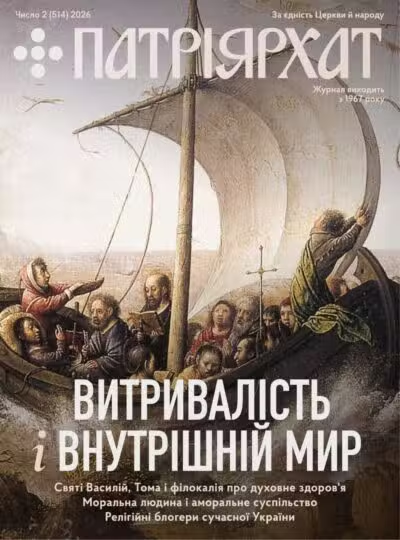
The Ukrainian Greco-Catholic Church draws its roots in the ancestral lands of Kyivan Rus — a land steeped in martyrdom and inseparable from the turmoil of imperialistic claims to the East and to the West. After centuries of Russian, Polish and Soviet domination, the UGCC resurrected from the catacombs in a context where the threat to the Ukrainian nation, its language and its culture remained palpable. For the everyday Ukrainian amidst the full-scale Kremlin-launched war of aggression, it would be understandable if this existential threat were to supplant all other concerns. Even in the Church, there can exist a temptation to rebrand the mission as one of safeguarding and upholding the nation, and it is in this context that French Canada offers to Ukraine its cautionary tale.
I. The French-Canadian Experience: A Church Recast as Nation-Builder
On the North American continent, in the second half of the 18th century, New France fell to the British after the famous battle of the plains of Abraham. The “Canadiens” found themselves stranded — a conquered minority of French-speaking Catholics within an English and Protestant empire. During the 19th century and the first half of the 20th century, the Roman Catholic Church ensured the role of guardian of the French-Canadian national identity. The Roman clergy, aware of the danger of assimilation, emphasized the fusion of the French language and the Catholic faith. Bishop Louis-Francois Laflèche of Trois-Rivières would coin the expression «la foi garde la langue, la langue garde la foi» (“faith preserves language, language preserves faith”) which would be zealously repeated for more than 100 years.
Rather than promoting the mission of the Church oriented toward the salvation of all humankind, many in the hierarchy recast it as a form of ethno-cultural rampart. Fully intertwined in every aspect of French-Canadian society — in healthcare, in education, in social services, in economic life, in community organizations and in the media — the Church appeared stronger, but it was often inward-looking. This ethno-centric attitude caused its schools, for examples, to turn away young Catholic immigrants of Italian, Irish, Polish or Ukrainian descent — redirecting them rather to English schools. While French Canada was one of the world’s greatest centers of Catholic missionary dynamism (sending thousands of priests, religious brothers, and sisters on every continent), it remained paradoxically closed and anxious on its home soil. Crushed by the fear of cultural dilution on a large anglo-protestant continent, it was willing to suspend the Great Commission.
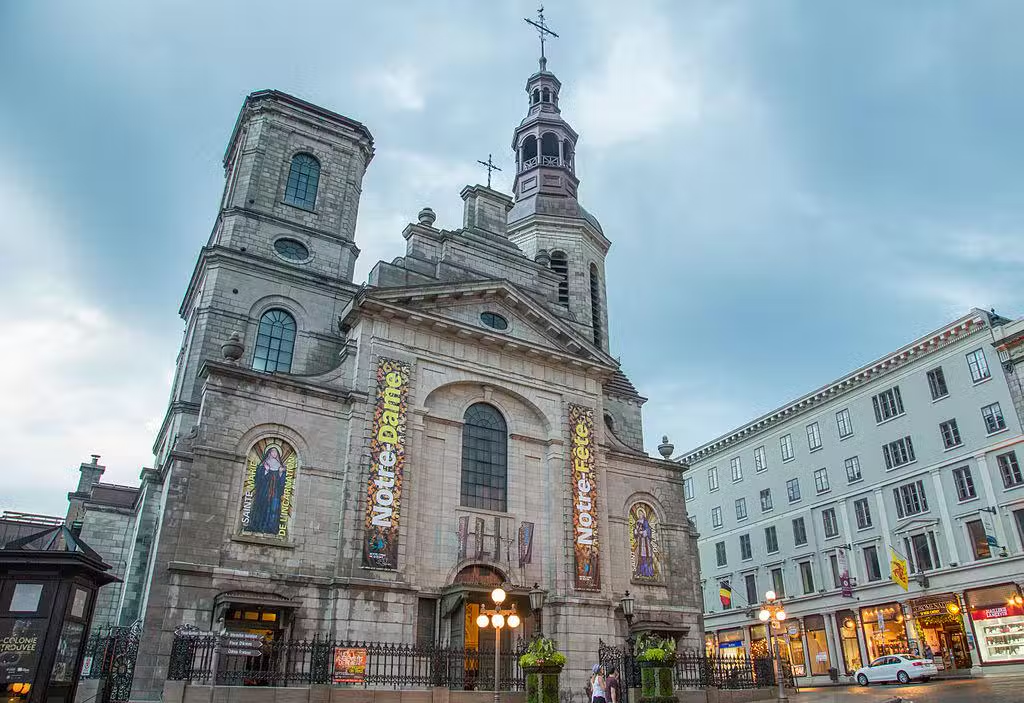
Such a clerical nationalism severely compromised the spiritual credibility of the Church. When, in the 1960s, French Canadian society was secularized by the «Révolution tranquille», its nationalistic movement had no hesitation doing away with old-fashioned ecclesial ties. The French-Canadian Church, too deeply entangled in worldly rather than supernatural affairs, had little spiritual authority. Within a single generation, the Catholic Church, previously omnipresent, vanished from the Canadian public square. Children of this new society have largely grown up without a sense of transcendence or the sacred, and the Canadian province of Quebec has become a spiritual desert unlike any other in North America. Its cities are filled with stunning churches that remain mostly empty and are being transformed into condominiums at an alarming rate. Its street names constitute long litanies of saints whose intercessions are no longer petitioned.
II. Parallels and Risks Today
Today’s Ukrainian society, like the early 20th century French-Canadian society, is faced with an existential threat. Despite notable differences in geography, language, culture, ecclesial rite, and in the nature of this societal threat, the parallels between the French-Canadian Church and the Ukrainian Greco-Catholic Church are striking.
The Evil One, or διάβολος, is “he who divides”. To achieve his goals, he is recycling an old strategy and tempting the faithful to define their Church along ethnic and national lines, above their duty to proclaim the life-giving gospel. In North America, some parishes can cultivate a resemblance to cultural centres, with a primary focus on the promotion of language and cultural practices, such as acrobatic folk dance or the preparation of flavourful cabbage rolls. UGCC parishes are at risk of understanding themselves not to be “from the Ukrainian people” but “for the Ukrainian people”. One can hear echos of Bishop Louis-François and his conflation of Church and nation: «Віра батьків — мова батьків» (“the faith of the fathers — the language of the fathers”). Far from the beloved homeland itself under a cruel siege, there can be an increased desire to protect cultural roots, even to the point of alienating those who, though of Ukrainian descent, do not feel or are not perceived as Ukrainian enough. Like the French headmaster of old, there can certainly be a temptation to send away from the parish the young seeker of Italian, Irish, Polish or French descent, and to recommend rather the “English” parish.
The cautionary tale of the decimated French-Canadian Church should not be ignored: when a Church builds itself on the sand of even the most beautiful cultures rather than the rock of the Gospel, it is bound to fall with a great crash (Matthew 7, 27).
III. The UGCC outside of Ukraine: A Branch Grafted onto a New Tree
As of 2025, the UGCC counts 36 eparchies and exarchates – 16 in Ukraine, and 20 others around the world. In Canada, for example, our Church has been present and has been ministering to souls since the 1890s and underwent formal canonical recognition in 1912 as an apostolic ordinariate under Blessed Nykyta Budka. Over time, the descendants of those who first brought our beautiful Church to North America have almost always inter-married; they rarely speak Ukrainian, and while they may cherish their Ukrainian roots, their national identity is Canadian. The branch has been grafted onto a new tree, and it bears good fruit (John 15, 1–5).
The flourishing of our Church points to powerful evangelical reality, highlighted by patriarch Sviatoslav: “The Ukrainian Greco-Catholic Church is not a Church made up solely of ethnic Ukrainians … It is a Church that comes from the Ukrainian people, but it is a Church that is for the entire human race.”
This Kyivan Church of Canada, with its 130-year-old roots, has a beautiful double vocation. On one hand, its parishes form networks of strong and established communities, well equipped to welcome, shepherd, and support those who are unjustly forced to flee their native Ukraine with a heavy heart. On the other hand, it is called to be a missionary Church here and now, proclaiming the Risen Christ to Canadians, a spiritually orphaned people.
The UGCC cannot afford to define itself primarily as a guardian of ethnic memory, however noble that memory may be. Its parishes must not become museums of a wounded past but living fonts of grace for the present and the future. This does not imply the abandonment of language, chant, iconography, or memory. On the contrary, when these are offered as gifts rather than imposed as boundary markers, they become powerful evangelical tools. The tragedy of the French-Canadian Church was not that it loved its culture too much, but that it allowed culture to eclipse mission.
The UGCC in Canada now stands at a similar crossroads. It can choose to remain a Church from the Ukrainian people and yet become unmistakably a Church for Canada. This requires a conscious refusal of ideological nationalism (a distortion of patriotism), a willingness to worship, preach, catechize, and serve in the languages of the land, and an openness to those who come not seeking cultural belonging, but spiritual nourishment.
If the Ukrainian Greco-Catholic Church in the English-speaking world resists the temptation to confuse evangelization with nation-building, it may avoid the fate of the French Church in these lands. Rooted in the blood of martyrs who once lived on the shores of the Dnipro, this resilient and radiant Church may also flourish on the shores of the St Lawrence — not as a refuge reserved for one people, but as a luminous witness to the universality of the Gospel.
Pascal Bastien

